
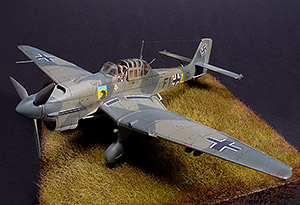
Italeri Ju87 B2 "Stuka"(Italeri scale: 1/72)
|
 |
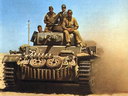
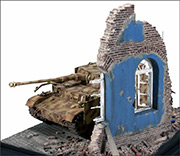
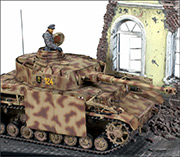
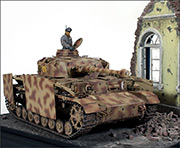
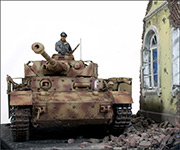
Gallery entry: Panzer IV Ausf. H (Tamiya scale: 1/35)
|
|
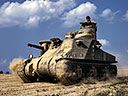
Gallery entry: Sherman M4A3 (76)W
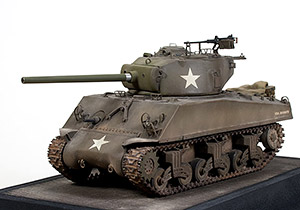 |
I never built a 1/48 scale model before and I must say it was a pleasure. Lots of detail you normaly not get in 1/72 but not at the price of 1/35 scale. The kit itself was a nobrainer, fit was good etc. The only two things that let the kit down were the horrible 76mm gun (it looks like a straw) and the 50 cal. machinegun is a bit oversimplified. So I ordered an aftermarket barrel a .50 cal. (Hauler) and for the hell of it a pe set (also Hauler) although I didn't use everything from that set. |
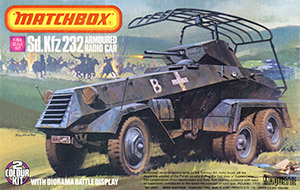
Matchbox addition: Sd.Kfz. 232 Armoured Radio Car (PK-85)
|
The Sd.Kfz. 232 first entered service with the Reichswehr in 1933, based on the standard three axled truck chassis but featuring major new concepts in armoured car design by having a direction-change gearbox, enabling the vehicle to be driven forward and reverse in four gears. The Sd.Kfz. 232 formed the backbone of the German Armies Armoured Reconnaisance Corps. With its increased armour protection and fire-power of the vehicle this enabled deeper reconnaisance missions in enemy held territory which were vital for the success of any attack. Sd.Kfz. 231's 232's (FU) armoured cars were used in the German pre W.W.II annexations of Austria, Sudetenland, Bohemia, Moravia and the Memel's. They were also used throughout the Polish campaign and the early part of the invasion of France before being withdrawn from front line service, and used in Training and Policing duties. |
|
Gallery entry: German Flak 37 3,7cm anti-aircraft gun
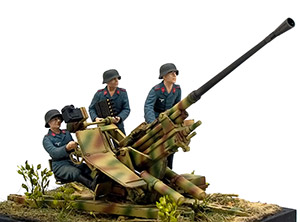 |
Easy to build kit. Some drawbacks are the age of the kit (not very much detail) and the figures who are clearly not from tamiya (probably Miniart), this hampers the fit of the gunner. |
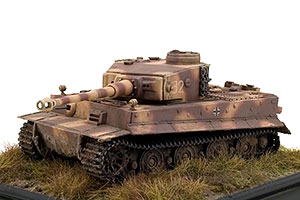
Gallery entry: Pz.Kpfw.VI Ausf. E Sd.Kfz. 181 "Tiger I"
|
This is the Gruppe Fehrmann Tiger from Dragons Armor Pro 1/72 scale series, alhtough I didn't build it as one from this unit.
Fairly straightforward to build except for the running gear, it gave me some headaches. |
 |
|
Gallery entry: Stürmgeschütz III Ausf. C/D Sd.Kfz. 142
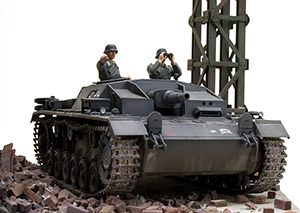 |
My second stug, this time DML's Stug III ausf. C/D complimented with their stug figure set. The kit was nice to build, no problems at all. Groundword and the building were made from styrodur and the tower was made from evergreen. |
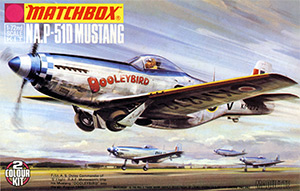
Matchbox addition: NA.P-51D Mustang (Mustang Mk. IV/P51-D) (PK-13)
|
In January 1940, the British Government requested North American Aviation to build under licence another company's design. North American however, proposed a completely new fighter - the Mustang, producing the first prototype in 117 days. Early machines entered service with the R.A.F. in July 1942 fitted with the Allison engine. Performance, excellent at low level, was not suitable for normal fighter operations and the aircraft were used on ground attack missions only. Little interest was shown by the U.S.A.A.F. until the Rolls Royce Merlin 61 engine was successfully fitted as an experiment. An order for several thousand aircraft using Packard built Merlins followed, the P51.D. version becoming perhaps the best propeller driven fighter of W.W.2. |
|
Matchbox addition: PanzerJaeger IV L/70 (PK-87)
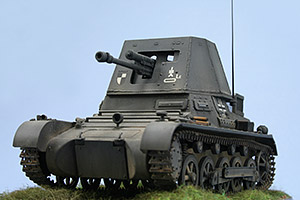
Gallery entry: Panzerjäger 1 Ausf. b 4,7cm PaK(t) (Sf)
|
I guess this one is an old Italeri kit, it has the 70's written all over it and i've seen the included (terrible) figure before. |
 |
|
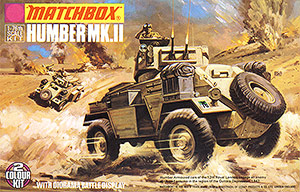
Matchbox addition: Humber Mk. II (PK-75)
|
First introduced in 1941, the Humber Armoured Car was first used as a light, mobile reconnaissance vehicle and as such were often in action. A total of 5,400 Humber armoured cars were produced. With a top speed of 45 m.p.h. and a range of 250 miles, the Humber was found to be highly effective in the Western Desert campaign due to it's manoeuvrability in the open desert, although the engine life was reputed to be limited to only 3,000 miles. Humber armoured cars also served in Europe in an anti-aircraft capacity with armoured Car Regimental Headquarters. |